

Gloriavale’s “Volunteers” Enter New Phase Of Employment When A Court Orders The Government To Hand Over The Awkward Advice
Disclaimer:
Pavlova Post is a satirical news publication. The events, quotes, organisations, and individuals described in this article are fictionalised for humour and commentary. Any resemblance to real persons or actual events beyond the referenced news story is coincidental.
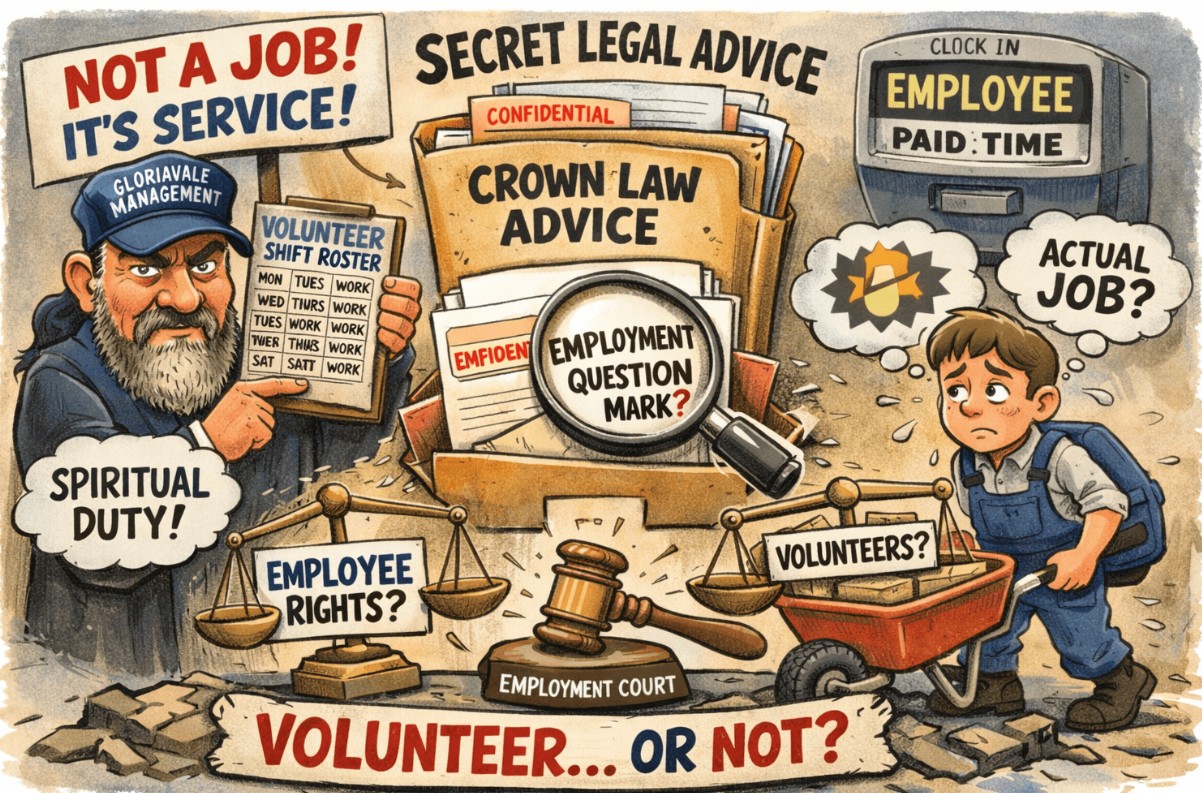
The roster is just spiritually aggressive
Volunteering, But With A Roster And Consequences
New Zealanders love volunteering. We do it in high-vis vests at school galas, in jandals at sausage sizzles, and in a deep emotional fog at the end-of-year “can you just help us move this one thing?” which is always a piano and never a cushion.
So it’s only fair that the nation is once again fixated on Gloriavale, where “volunteering” has historically looked less like “pop in for an hour” and more like “welcome to your lifelong shift, please bring your soul and a packed lunch.”
The latest twist: the Employment Court has ordered the government to disclose Crown Law advice connected to the long-running fight over whether Gloriavale members are employees or volunteers — the legal equivalent of HR being forced to forward the email chain titled “DO NOT FORWARD.”
And instantly, every Kiwi workplace has felt a tremor of recognition: the moment when the official story (“it’s not a job”) collides with the practical reality (the roster is laminated).
When Does ‘Helping Out’ Become Work?
The word “volunteer” is meant to feel optional. It suggests you can leave without submitting an exit interview, a spiritual statement, and a handwritten apology for having knees.
In the normal world, volunteering is:
- show up,
- do a thing,
- eat a stale muffin,
- go home.
Employment is:
- show up,
- do a thing,
- be supervised while doing the thing,
- suffer consequences if you don’t do the thing,
- get paid (or at least promised that you will be, eventually, once “the budget allows”).
Gloriavale’s system has, for years, occupied that awkward middle ground where people work full-time but the word “work” is treated like swearing in a church foyer.
To outsiders it can resemble employment wearing a cardigan labelled “devotion,” but inside the cardigan there’s still structure, oversight, and the universal workplace sensation of being “needed” in the way a forklift is needed.
And New Zealanders are nothing if not familiar with the cardigan. We have all worked somewhere that called you “family” right up until you asked for time-and-a-half, at which point you were upgraded to “disruptive element.”
The National ‘Not A Job’ Bingo Card
Because the country cannot help itself, workplaces everywhere immediately started playing “Could we say that too?”
Squares include:
- “We don’t have staff, we have a whānau.”
- “There’s no overtime here, only commitment.”
- “Pay isn’t everything. (But also, we will not be providing any.)”
- “Please submit your leave request to the concept of gratitude.”
If you hit a full row, you win a mug that says Team Player and a calendar invite titled “Quick Catch-Up” that will, in fact, ruin your week.
Pull Quote
“It’s not labour, it’s love,” said the organisation, while the rest of New Zealand quietly asked if love can please start contributing to KiwiSaver.
Why The Court Order Feels Like A Big Deal
Crown Law advice is usually guarded like Nana’s pavlova recipe: not because it’s perfect, but because once it’s out, everyone starts arguing about whether it ever worked.
So when a court says, “hand it over,” it’s not small potatoes. It signals that the advice matters to the legal arguments — particularly around who knew what, when, and whether anyone waited too long to act.
If you’ve ever worked somewhere that suddenly “found” a missing policy document the moment an employee asked for it, you already understand the vibe. It’s the corporate equivalent of “Oh wow, the policy has been here the whole time,” while someone quietly deletes last month’s message that said, “We don’t actually have a policy.”
The public doesn’t need to know every procedural detail to understand the emotional core:
- one side wants the system recognised as employment,
- another side wants it recognised as “community life,”
- and the court is effectively saying, “Bring the paperwork. We’re done with vibes.”
Timeline: From ‘Service’ To ‘So… Who’s The Boss?’
- Long-running status quo: Members contribute labour as part of community life; critics argue it functions like employment.
- Growing scrutiny: Questions rise about employment rights, obligations, and what “volunteer” can reasonably cover.
- Legal trench warfare: Definitions, documents, and procedural fights multiply like leftovers in a shared fridge.
- Latest twist: The court orders disclosure of Crown Law advice, because this dispute has reached the point where even the footnotes are relevant.
Internal Memo: “Volunteer Alignment & Output Optimisation”
To: All Volunteers (Please Remember You Are Not Employees)
From: Management (Please Remember We Are Not Managers)
Subject: End-Of-Year Productivity & Attitude Refresh
Team,
As we enter the festive season, we’d like to remind everyone that you are not “working,” you are “serving.” This is a critical distinction for morale, branding, and certain administrative arrangements we do not wish to discuss.
Please note:
- Attendance remains mandatory in the same way that breathing is “optional.”
- If you feel tired, please consult the approved list of uplifting thoughts.
- If you feel injured, please report this promptly so we can confirm whether the injury is worldly or character-building.
- If you have questions about pay, please re-read the phrase “community life” until it becomes soothing.
- If you use the word “employee”, please replace it with “valued contributor” and then sit quietly until the urge passes.
Kind regards,
Management (Not Management)
The Red Flags Every Kiwi Instantly Understands
If you’ve ever had a boss say, “we’re all a team here,” and then immediately ask you to cover someone else’s shift without overtime, you already know the red flags.
Here’s the checklist the country is silently running:
- set hours or schedules
- supervision and direction
- performance expectations
- consequences for non-compliance
- the organisation materially benefits from the output
Tick enough boxes and you’re not “helping out.” You’re doing a job, even if the job is wrapped in inspirational language and a stern talk about gratitude.
That’s why the Crown Law advice feels spicy: because it’s likely where someone had to write the uncomfortable bits down in calm, adult sentences.
Meanwhile, In Regular Kiwi Workplaces
The rest of the country is watching this like it’s a training video with surprising production value.
Because even if you’ve never been near Gloriavale, you have been near:
- the “trial shift” that turns into a second trial shift,
- the “casual” contract that is mysteriously full-time,
- the “just help out” request that becomes a permanent line in your job description.
It’s why this story hits a nerve. New Zealand has a proud history of muddling through, but we also have a proud history of muddling through while someone else calls it “culture.”
What Happens Next: More Paper, Less Pretending
The case will continue doing what all major workplace disputes do: expanding into a full ecosystem of documents, arguments, and increasingly specific definitions of “volunteer.”
The government will keep trying to sound neutral while also avoiding a precedent that makes half the country’s unpaid “trial shifts” look like a confession.
And Gloriavale will likely continue insisting the system is community life, not employment — even as the rest of us keep squinting at the same basics we’d use anywhere else: control, hours, oversight, and what happens if someone says “no.”
In the meantime, New Zealand heads into Christmas with the same comforting truth it always has: whether you’re in an office, a shed, or a “community,” the drama starts the second someone pretends a roster isn’t work.