

‘I’ve Blamed Myself For So Much’ Beyond the Gates of Gloriavale:
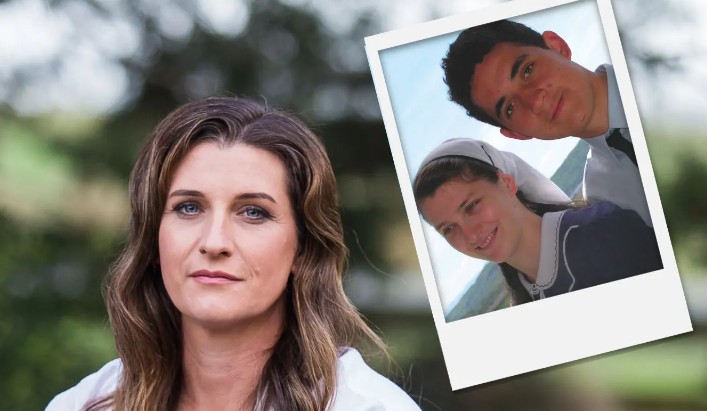
Leaver Rosie Overcomer Shares How Becoming a Mother Herself has Been ‘a Confronting, But Freeing Journey, Releasing the Blame & Shame’ of Heartbreaking Childhood Abuse
Rosanna Overcomer left the Gloriavale community 13 years ago, alongside her husband, Elijah and their three small children. In the years since, Rosie and Elijah have gone on to have three more children, whilst Rosie has become a champion for change within Gloriavale. She bravely walked into the Timaru police station to report years of abuse within the walls of the controversial community, in a bid to stop other children going through what she had survived. Here, she talks to Alice Hampson about what life was really like within Gloriavale, how difficult it was to leave and start again on the outside, as well as where her relationships with the community sit now (a large portion of her family, including her parents, are still living there).
TRIGGER WARNING: This story discusses abuse, child abuse, sexual abuse
It was the simple things that were truly bewildering in those first few weeks and months after Rosanna Overcomer left Gloriavale alongside her husband and three young children.
A friend on the outside introduced her to Google, which she was soon feeding everything through: What is ‘potluck’? What’s a normal way to celebrate a four-year-old’s birthday? What is Friends and why is everyone referencing it?!
The supermarket felt overwhelming. The entire world felt overstimulating. She didn’t know what to wear, how to make all these little decisions every day that she’d never been allowed to make for herself.
“I remember the first birthday party we got invited to,” says Rosanna. “Someone said, ‘just bring a plate’ and I thought, ‘what!? I don’t know what that means. I’ll have to Google it – or just look stupid as a mother of three to have to ask someone what that means.’ I really beat myself up over those things. I’d look at everyone and think, ‘I’m a mum. I’ve got three kids and I don’t know what any of this means? Why am I struggling so much when everyone else seems to find it normal and easy? How are these mums just driving their kids around? I felt really behind and really inadequate – both socially, and as a mother, in every aspect.”
Rosie, now 40, moved from Springbank into the Gloriavale community as a young child. She was the sixth of 10 children in a family that she describes as ‘quite low’ within the community. Being a woman put her even further down the pecking order. “In Gloriavale, the structure is men at the top and women at the bottom,” she says.
In 2013, she and her husband Elijah left the controversial Christian fundamentalist community, aged 27, with their three young kids in tow. They’ve since had another three children together in a marriage that has survived every test that’s been thrown at it.
Leaving the Gates of Gloriavale
It was Elijah who first pushed for the family to leave. They’d recently had their third baby when Elijah was removed from Glorivale after he confronted Hopeful Christian, the late founder and former leader, about his criminal conviction for sexual abuse. Elijah believed the community weren’t being told the truth. The community’s response was to evict him. In an attempt to keep the pair apart, Rosie and their three children were flown on a private aeroplane and put into hiding in a remote location. There, she wasn’t allowed contact with Elijah or the outside world for six weeks – she describes it as a kidnapping. After the ordeal, the family left for good.
But Rosie says their plans to leave had really been simmering for a while. Her first real that something had to change, came when her first child, a baby girl named Honour, was just two weeks old.
Back then, she hoped they wouldn’t have to do something as drastic as leave – she hoped changes could be made. “I didn’t really consider leaving as an option that early on, although I did know if the place didn’t drastically change by the time my daughter was seven, living there would no longer be an option. We imagined all parents in there would want their children to have safety,” she says.
She writes about it in her incredible new autobiography, Beyond the Gates of Gloriavale: What it Takes to Survive & What it Takes to Leave and describes the feelings that overcame her, looking at her new baby peacefully swaddled up in a pink floral sheet she’d made herself.
“The sight of her lying peacefully in her bed did something to me. I realised that this little girl needed me for absolutely everything. For the first time in my life, I saw just how vulnerable I had been when I was a child, starting from when I was seven years old, I knew my baby wasn’t safe here. In my mind, we had until she was the same age to find a way to protect her.”
Seven is the age Rosie remembers her own abuse beginning.
It happened in the place where she was supposed to be the safest: tucked up in her own bed, asleep in her family’s home.
“Most of the serious abuse that I suffered or went through, I was in my bed,” she says. “Every time, I’d wake up and there was someone else in my bed.”
Rosie says that finally acknowledging what happened to her as a young child, opened the floodgates and pushed her to help other children. “Once I acknowledged that for myself, that my childhood was unsafe, I knew it was the same for all the other girls – and some boys too.”
In 2015, two years after leaving Glorivale, Rosie walked into the Timaru police station and told them about some of the men who had harmed her. “I felt it was my duty to stop them from doing any more damage,” she says. She was at the station for three hours.
“Even so, I didn’t tell the police officers everything,” she writes in the book. “There was much more, much worse. Things I didn’t even feel like I could say, things I still haven’t said. I might go to my grave with some of them.”
Speaking to me today, she says back then she didn’t even have the language to describe what had happened to her. “I probably didn’t tell the police enough, I mean, I know I didn’t because I was so terrified,” she says. “Terrified of the repercussions.”
There was fear, and there was shame. The story she’d been told for years was that she was to blame. All women were.
In her book, she writes: ‘We were taught that women had all the power in one instance only, and that was when it came to sexual things. Women had the power to tempt a man, to turn a man away and to cross her legs. A man had no power at all over himself when he was sexually attracted to a woman, and so the woman was responsible for any sin the man committed. If a man had sex outside of marriage it was the wife’s fault for not giving him what he wanted, and the girl’s fault for not saying no. I didn’t understand how two different women could be to blame when one man did wrong.’
This all became even more confusing to her when the abuse began. With no locks on any doors, anyone had access to her bed when she was asleep. She remembers one particular night waking up to find a man in her bed again.
‘My mother called out, ‘Is there someone in our room who isn’t supposed to be?’ I watched him crawl out of the room and I assumed she did too.’
It’s been a long, difficult journey for Rosie to feel safe again. It’s only recently, she says, that she stopped attacking her husband in her sleep, convinced he was an intruder.
“For years after we left – even when we were inside Gloriavale, but it really manifested after we left – if he came to bed later than I did, when I was in that half-asleep state, I would fight him,” she says. “I would actually fight him, slapping him, yelling, and he’d have to convince me that it was really him. We were just talking about it the other day that I haven’t done that in ages.
“It’s just feeling safe,” she says. “It’s amazing. I wake up and feel like I’ve slept.”
Having children of her own has been triggering, but also healing.
“When I see them hit an age where I have a memory – a very clear memory of being abused, seeing them that age has me really realising all over again how much of a child they are and that it’s an adults’ job to protect them, not put them in those situations,” she says.
It’s fresh, Rosie says, because her youngest is only eight. Watching them, seeing how perfect and young and innocent they are, has allowed her to lift some of the shame and blame she’s placed on herself for decades.
“Looking back, I’ve blamed myself so much,” she says. “Y’know, ‘I must have been too friendly’ or something – or, just when you’re told those things enough, you unknowingly start to believe stuff that you’re told about yourself.
“But seeing my 12-year-old daughter asleep in her bed, I’m like, no, there’s no way that was my fault. It’s been confronting but really, I guess a freeing journey for me to release some of that blame and the shame around it for so long. Because actually, no, I was a kid.”
Gloriavale Today
A large portion of Rosie’s family still live within Gloriavale (“We have just ticked over having half of us out,” she says). The decision to leave was huge. She knew it meant her relationship with her parents and her brothers and sisters was about to change. She knew it could be the end of their relationship.
READ MORE:
- ‘At Gloriavale, We Were Not Allowed To Have Imaginations.’ Theophila Pratt On Growing Up In Gloriavale & Re-Learning Everything Once She Left At 18
- ‘It’s Death By A Thousand Cuts’: Are We Starting To See The End Of Gloriavale? A New Documentary Shows The ‘Turmoil’ Inside
- ‘You’ve Got No Idea Of The Harm That’s Going On In There. Because Gloriavale Breaks People’
It has been fraught, but they still communicate. Rosie and Elijah still visit with the kids – although they don’t let the kids out of their sight.
“We were there last week,” she says. “It’s quite strange now. People have got so much freedom, which is good.”
Rosie says, as she knows only too well, the transition from having all your choices made for you, to suddenly being asked to choose for yourself, can be testing. “It can be really hard to make decisions when you’ve never had to before and now I guess, they’re going through that a bit within Gloriavale where they’ve been given a bit of their autonomy back, but they don’t actually know what to do with it.”
There’s been a number of changes – there’s more contact with the outside world, more people with mobile phones, women with driver’s licenses and cars. But there’s still work to be done.
Rosie says she’s felt more comfortable going back in recent years, but the first visits after leaving were difficult.
“I hit really strong feelings,” she says. “I remember the first couple of times I went up there I just felt this overwhelming sense of fear. It felt like a heavy weight and when I’d leave, I felt like I could breathe again.”
She’s aware that writing this book could have repercussions on her relationships with those still inside.
“I definitely have fears,” she says. “I mean, this morning a box of books arrived and I looked at it and straight away thought ‘oh, there’s going to be people that hate me’. But it’s done now. I’ve obviously decided I’m okay with that.”
Her other great fear of writing the book was making sure that she didn’t tell anyone’s else’s story – that she kept it just to her own experiences and her own interpretation of things. She didn’t want to get anything wrong, but, moreso, she didn’t want to tell anyone else’s story for them.
“I guess I’m aware of that too because I’ve had that done to me too,” she says. “People have taken my story – and not just people that are from Gloriavale. I didn’t want to do that to anyone else.”
Rosie says a surprisingly – and alarmingly – large number of people have said to her over the years that they know her story, even better than she does. “Yeah, many times people have said things like, ‘Oh, I know your story better than you because I can look at it objectively.’”
She says there’s a number of judgements and assumptions that people make of her, and of Gloriavale, that they’re often far off the mark with.
There are so many different aspects to Rosie’s story and she so beautifully writes about them in Beyond the Gates of Gloriavale. It’s truly an exceptional read. As I say to Rosie, her exact situation may be very unique, but anyone reading it, whether you’re a sister, a daughter, a mother or just a woman, you’ll find yourself connecting with Rosie and her experiences. It’s beautifully written – although it’s a difficult read at times – but such a triumph.
Rosie says she wrote the book as a record for her kids to read one day when they’re older. “Maybe they might understand me a bit better,” she says.
But beyond that, she hopes it’ll connect with other women, whatever is going on in their lives. “I wanted to have a record of it, because that’s what it will become one day – it will just be history when I’m gone. I want people to take from it whatever they need to – because I assume that most people can relate in some way to something in it. I know Gloriavale, not many of us come from there, but there’s lots of situations, suffering different abuse, coercive relationships, even just being a mother. I just hope they can take away from it whatever they need to know that they’re not alone.”
Beyond the Gates of Gloriavale: What it Takes to Survive & What it Costs to Leave, by Rosanna Overcomer is available now